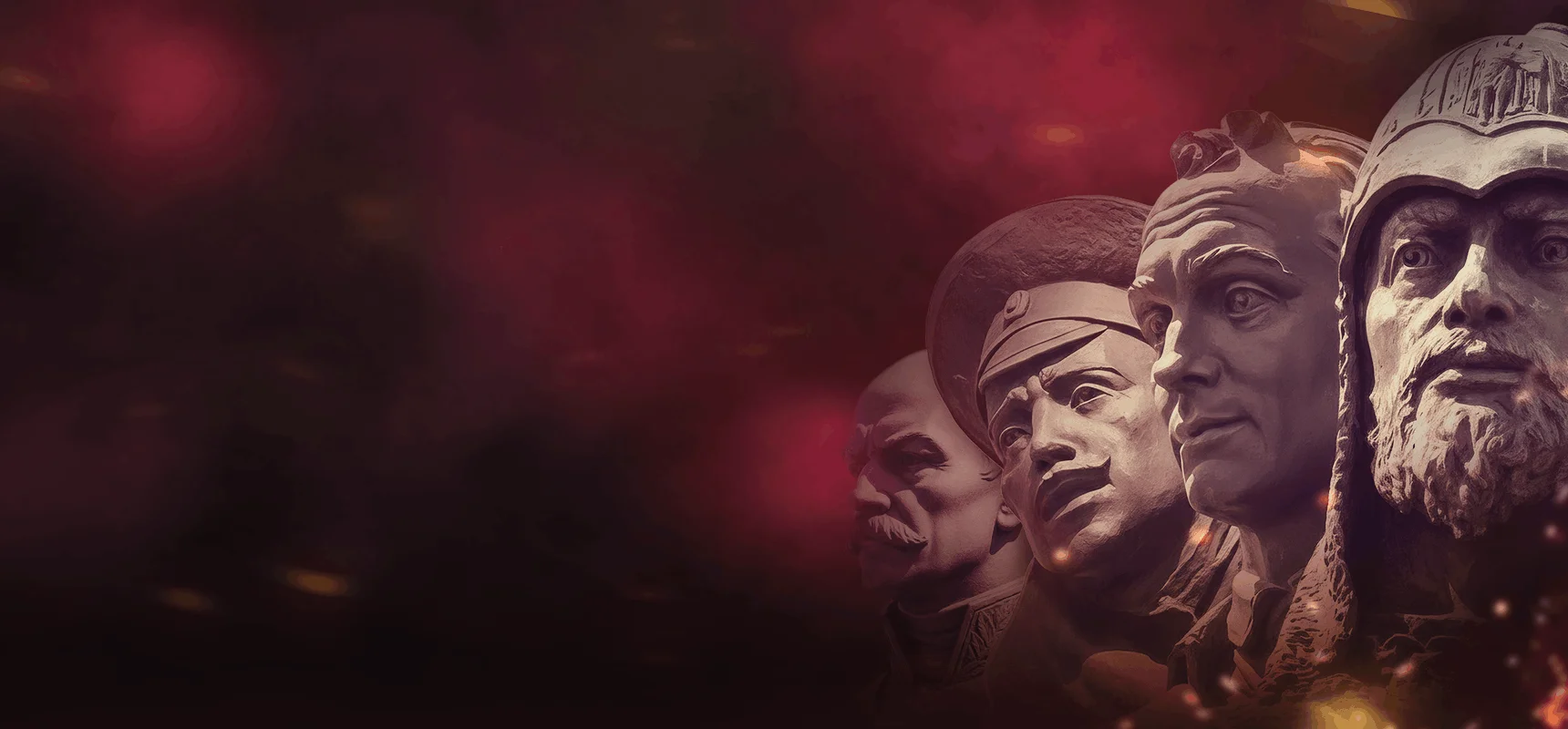
Military Commanders of Russia
- История
- 5 episodes
- 2023
How did Alexander Nevsky manage to combine the qualities of a fearless warrior and a subtle diplomat? Why did Stalin entrust Tolbukhin with liberating the largest European capitals? What is the secret of the boundless popular love for General Skobelev? Is it true that Suvorov and Yudenich never lost a battle? In our video lectures you will find answers to these and other questions.
Hosts
Episodes
Fedor Tolbukhin Dubbing on request
Military Commanders of Russia • 2023 • 26 minutes
Under Marshal Tolbukhin’s command, Soviet troops liberated seven capitals of European states. Of these, three capitals were liberated personally by his troops. No other Soviet commander among the military leaders can claim such a distinction. Thirty-four salutes were held in honor of Marshal Tolbukhin’s troops. At the outbreak of World War I, Fyodor Ivanovich Tolbukhin was drafted into the active army. However, he was not drafted into the infantry or artillery but into a motorcycle unit which was considered an elite of some sort. Even there, he managed to prove himself quite quickly and was subsequently sent to the warrant officers’ school. He received his first officer rank and rose to the position of battalion commander. Apparently, his desire to be a military man manifested itself. Some inner trait, it seems, played a role. His relations with subordinates are characterized by the fact that, in 1917, after the revolution, soldiers elected him chairman of the regimental committee — an position equivalent to regimental commander and reflecting the authority that officers and commanders typically held in that regiment, something not often seen in other units. Thus, in the early years of World War I, two of his qualities manifested themselves: a strong military orientation and, secondly, humanity and a noble attitude toward people in the true sense of the word. These qualities later enabled him to interact very successfully with any commanders and superiors, and accordingly, to educate his subordinates. The title Hero of the Soviet Union was awarded posthumously in 1972 under Leonid Ilyich Brezhnev. This is a remarkable fact. All commanders — not only those of the first echelon, such as Marshals of the Soviet Union, but also those of the second echelon commanding armies, flotillas, and other military leaders — generally held one or two Stars of the Hero of the Soviet Union. Suddenly, the Marshal received the Order of Victory and other orders but was not awarded the Hero of the Soviet Union. This is a surprising paradox; perhaps it lay in his modesty and his unwillingness to present himself as an outstanding or heroic figure and a military leader, which may have played a role in such outcome.
Alexander Suvorov Dubbing on request
Military Commanders of Russia • 2023 • 26 minutes
Alexander Vasilyevich Suvorov is the foremost commander in Russian history, not only of the 18th century but up to the present day. He served in the army for over 50 years, participated in six or seven wars, and won — or at least did not lose — roughly 20 battles. Neither in Russian nor Western history has there been a commander who served his country for so many years while refraining from political intrigues and scandals. He demonstrated unwavering military devotion to his homeland. He considered it his chief duty, as well as the duty of every decent person. Suvorov dedicated his entire life to military affairs, beginning in childhood when he sought military service against his father’s wishes. He remains in our generation’s memory as a commander — the only one since the 18th century — worthy of remembrance, respect, and study. Even in Soviet times, Suvorov schools were established, and many things — cities, ships, and more — were named after him. Certainly, the memory of Suvorov should not be forgotten today, because he teaches us to serve our Motherland, considering it the main purpose of life. Dedicate yourself to this mission boldly, without hesitation or regret. Devote yourself to the study of military affairs and all professions related to them.
Nikolai Yudenich Dubbing on request
Military Commanders of Russia • 2023 • 26 minutes
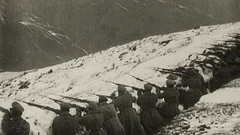
Perhaps Yudenich could be considered the foremost among all commanders. Why? The answer is simple: he did not lose a single battle or campaign, neither small nor large. The battles he fought were serious and significant operations that influenced not only the course and outcome on the Caucasus front but also the entire course and outcome of the war. He was a recipient of all the highest orders — the British Order of St. Michael and St. George, France's Grand Cross of the Legion of Honour, the Order of the White Eagle, and the Order of Noble Bukhara. In other words, he held all the highest military awards available at the time. How is it that so little is known about him? Yudenich’s name remained unknown to us for decades, primarily because we lived under Soviet rule. He was the staunchest enemy of Soviet power. There is a famous poster by artist Deni, widely recognized, depicting a map of the young Soviet republic and imperialists — the Americans and the British — sending three dogs against the republic: Kolchak’s shepherd and the two bulldogs, Denikin and Yudenich. Thus, he was portrayed as an absolute enemy, symbolically so. Who Yudenich was and what he did in World War I did not interest many — most importantly because he was a White general. Yudenich is a very tragic figure. He remained misunderstood not only by his opponents but also by his close circle and friends. He completely renounced all struggle against Soviet power because he believed that fighting Soviet power would mean fighting Russia. The tragedy of Yudenich is that he spent the rest of his life in a hopeless situation.
Mikhail Skobelev Dubbing on request
Military Commanders of Russia • 2023 • 26 minutes
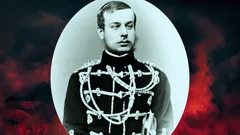
Mikhail Dmitrievich Skobelev was essentially a people’s hero. People called him that, and the title stayed with him for many years. It is no coincidence that when Skobelev died, the people mourned him, and there were lavish, heartfelt funerals. It was genuine sorrow for a great many people. This is striking because Skobelev lived in a time without cinema, television, or radio, yet his fame was spread by word of mouth. Skobelev somehow stood out to the people among numerous military figures. There were several reasons for this. One was that he was truly beloved by soldiers. He was a father-commander in the truest sense. Skobelev genuinely loved his subordinates and always helped them. Russia has been a country engaged in wars throughout its history, so the most popular figure was often the military hero. Skobelev was such a figure — a unique personality. He brought tactical-level conduct of combat operations to prominence: in the Russo-Turkish War, he first commanded a combined detachment, then a division. Undoubtedly, Skobelev rejected the rigid doctrines of the early 19th century regarding dispositions; he taught his subordinates and practiced reacting to changing situations. Skobelev said he both loved and did not love war — he was, in a sense, a poet of war. War was his natural element. He lived for war. He knew how to organize combat like a theatrical performance, while also believing that war must be approached with utmost caution and care. He always prepared thoroughly for wartime. All his combat operations were meticulously planned to minimize the use of force and resources and to preserve human lives. That was Skobelev.
Alexander Nevsky Dubbing on request
Military Commanders of Russia • 2023 • 26 minutes
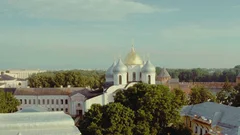
What was Alexander Nevsky like? Who is he to us? He was a prince and a commander — our spiritual guide, if you will. He is the father of the Great Russian tribe and a guardian angel of the greater Russian part of the unified, threefold Russian people. The Battle of the Neva is notable because, perhaps for the first time, Swedish forces were prepared not merely to raid but to establish a base for a future advance on Novgorod. Moreover, the Battle of the Neva and the Swedish campaign against Nevsky were part of an offensive against Rus’. These offensives unfolded like a fan across the entire front — from the Neva to the southern front in Pskov. The Ice Battle was regarded by contemporaries as a paramount victory that ended Western aggression, specifically Latin aggression. Undoubtedly, this victory is a vital part of our national self-awareness — a significant piece of our history. It serves as an archetype of victory over the Germans, which has been echoed throughout our history. Alexander Nevsky was seen as a grace bestowed by God upon the Russian land, and the people believed in this with all their hearts. Alexander understood that at that time, open confrontation with the Horde would result in the physical destruction of the Russian population. The choice was either to preserve the remnants of the Russian people or to disappear from history altogether. Nevsky was both a hero and a diplomat possessing a superb analytical mind who understood what to say, in which situation, where to bow, and what actions to take. Alexander Nevsky symbolizes the high culture of the Russian people. Courage — the highest virtue of the Russian person — is a profound part of our soul, and that, too, is Alexander Nevsky.