Leaders of Nations
- История
- 15 episodes
- 2021-2024
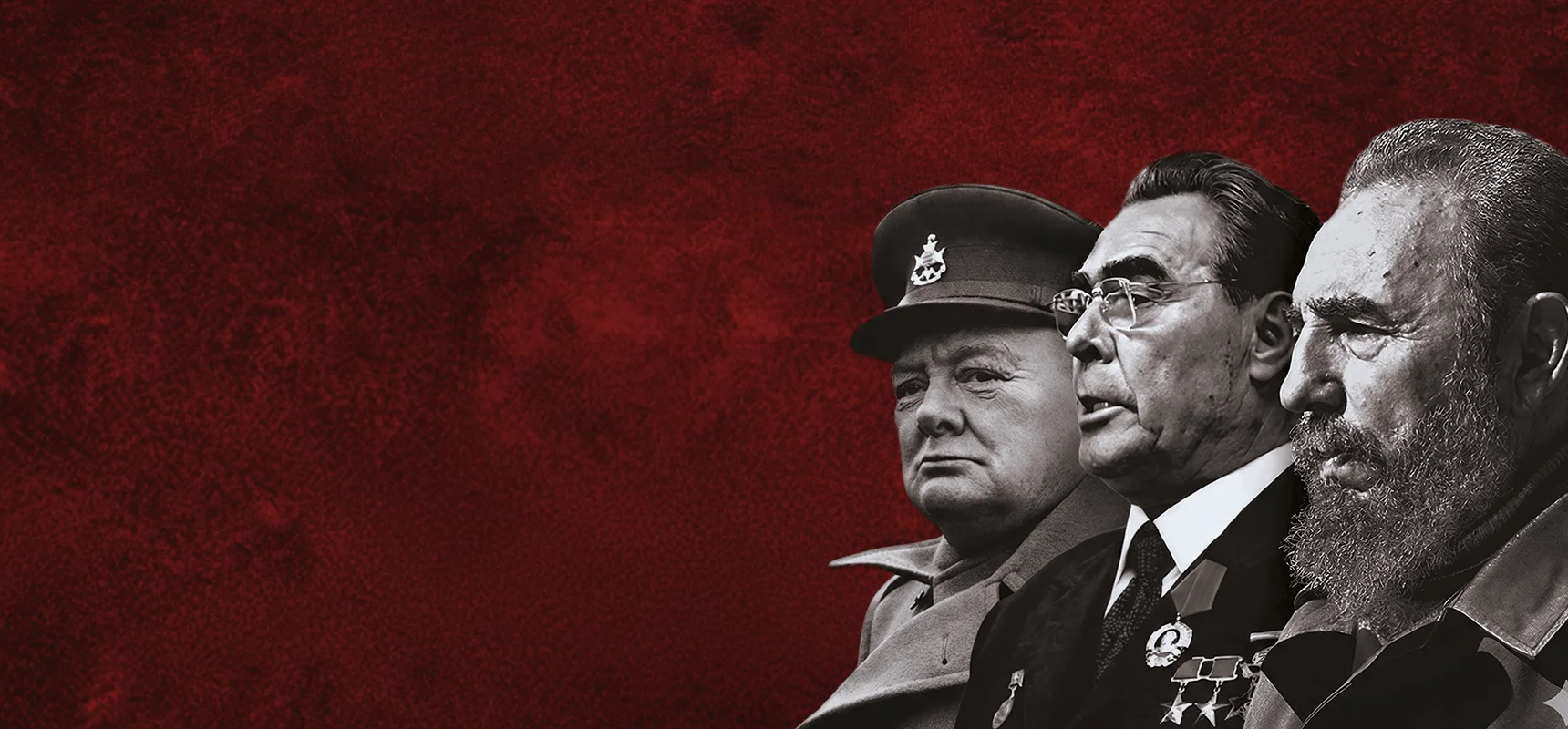
A series of documentary films about the biographies of great politicians who are rightly considered creators of 20th-century world history. How did these people come to the pinnacle of power? How did their political views form? Which of their decisions proved salvational, and which destructive?
Hosts
Episodes
Charles de Gaulle Dubbing on request Subtitles available (Russian)
Leaders of Nations • 2021 • 44 minutes
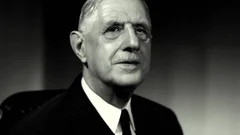
He survived 23 assassination attempts — none succeeded. Why did some adore him, while others hated him? What did he do for his country, and how did he envision France’s future? On June 18, 1940, de Gaulle delivered his famous speech calling on the French to form the Resistance. France did not immediately believe him, but Stalin did. Twenty years later, de Gaulle would request to be escorted to Stalin’s grave. The film includes exclusive footage of de Gaulle’s Cold War visit to the USSR in 1966, as well as a rare recording of the celebrated general addressing the Soviet people in Russian. De Gaulle was the first foreign leader honored to visit Baikonur. Weeks after his visit, France left NATO’s integrated command. What lay behind this decision? How did the USSR visit affect relations? And how did America react? The film also reveals many unknown aspects of the president’s personal life. At Nixon’s farewell, he said de Gaulle did not need a monument because he himself was a monument, his creation: France. The greatest Frenchman of the 20th century — Charles de Gaulle.
Chiang Kai-shek Dubbing on request
Leaders of Nations • 2021 • 44 minutes
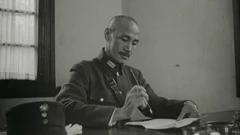
In 1928, war-torn China was united and led by General Chiang Kai-shek — a bright, authoritative, yet contradictory figure. He dreamed of building a society of general prosperity, but at times made decisions that cost many lives. His personal honesty was well known, yet his associates and family stole vast wealth during China’s darkest years. Chiang defended freedom and democracy throughout his life, yet he was a dictator who mercilessly eliminated political enemies. In the People’s Republic of China, any ties to him were punished by death; he was caricatured as a Western lackey. Historians continue to debate Chiang Kai-shek: some call him a bloody dictator, others a hero. What was China like under Chiang? Why did he hate the Communists? And why did he lose the civil war to Mao Zedong? The film offers answers and surprising facts from Chiang’s biography, including the Russian influence in his life and how his wife managed to persuade American politicians to listen. In 1949, Chiang lost mainland China but retained Taiwan, where he carried out economic reforms that helped transform the island into an "Asian tiger". Will history someday reassess Chiang’s legacy?
Franklin Roosevelt Dubbing on request Subtitles available (Russian)
Leaders of Nations • 2021 • 44 minutes
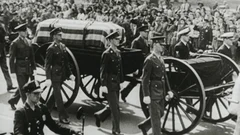
He became the only American president elected to a fourth term. Why did Americans call him the saviour of the nation, and how did Franklin Roosevelt lead the country out of the Great Depression? Why is the "New Deal" associated with his name? The film reveals many facts about the president’s private life: how he overcame illness and later disability, yet remained a highly active politician. Alongside Stalin and Churchill, Roosevelt shaped the postwar world; his ideas led to the creation of the United Nations. When Roosevelt died in April 1945, mourning flags were flown in the USSR — the first such case for a foreign leader — reflecting Soviet appreciation for his role in fighting Nazism. Why did Roosevelt believe in the Soviet Union, and why did hopes for peaceful relations fade after his death? Roosevelt’s life is a key part of his historical legacy.
Fidel Castro Dubbing on request
Leaders of Nations • 2021 • 44 minutes
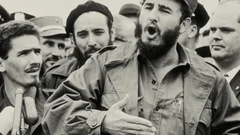
1962. In a secret operation, 85 Soviet ships delivered 40 nuclear missile systems to Cuba. Learning of this, U.S. President John F. Kennedy ordered preparations for an invasion of Cuba. The world teetered on the brink of catastrophe. Fortunately, at the last moment, leaders stood down. In exchange for removing the missiles, the Americans promised to cease attacks on Cuba and its leader, Fidel Castro. Castro’s personality remains fiercely debated. Some see him as an outstanding fighter against social injustice, tyranny, and slavery. Others call him a dictator who turned a paradisiacal island into one of the world’s poorest backwaters. Who was he really? A great statesman who outgrew his country? A man who bravely survived numerous assassination attempts — 638 attempts recorded in the Guinness Book of Records. Why was Castro’s first visit to the USSR kept so secret that he had to fly from Cuba to Moscow via Murmansk? What did that trip mean for Soviet–Cuban relations? He remained in power for almost fifty years. As they say in Cuba: "Nations in critical moments give birth to people who become national personalities". Fidel Castro is a striking example. The film invites reflection.
Winston Churchill Dubbing on request Subtitles available (Russian)
Leaders of Nations • 2021 • 44 minutes
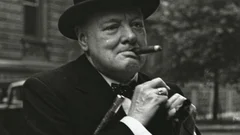
His funeral was comparable to a royal one. For more than 50 years, he served the British Empire and endured its decline. He hated communism, yet he made his stance immediately in June 1941. On June 22, his address to the nation stunned everyone: "We must give Russia and the Russian people all the help that we can. We must urge all our friends and allies in every quarter of the globe to follow the same course and to persevere therein, as we shall do ourselves, to the end". With these words, Churchill secured his place in history, even though he was later consistently seen on the side of good. The film presents unique footage of Churchill’s visits to the USSR and his relationship with Stalin. The politician’s eccentricity is underscored by the Nobel Prize in Literature he received; he did not attend the ceremony, snobbishly remarking, "A club with many members ceases to be a club". The film uncovers secrets of his political career and the rhetoric behind it. It may also shed light on Rudolf Hess’s flight to England. In 2002, Winston Churchill was officially recognized as a national symbol — just as he had wished.
Nikita Khrushchev Dubbing on request
Leaders of Nations • 2021 • 44 minutes
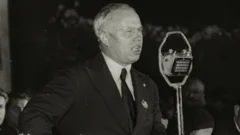
After Joseph Stalin’s death in 1953, no one could have predicted that the cult of the leader would abruptly end three years later. His body was removed from the Mausoleum, and the initiator of the denunciation would be one of his closest loyal comrades — Nikita Khrushchev. As leader of the USSR, he carried out major economic transformations, some later judged reckless. What did Nikita Khrushchev leave to his compatriots and foreigners? What facts in his biography did he dislike recalling? And why was he forced to resign? The film reveals unique documents that Khrushchev never mentioned. Archives have uncovered his resignation letter. The career of this ambitious provincial party activist is truly remarkable. He survived the 1937 repressions, came to power through conspiracy, launched the Virgin Lands campaign, initiated the space era, and was unafraid to denounce the Western world from the UN rostrum. How will history judge him? He reflected on himself in his memoirs. And what will his descendants say
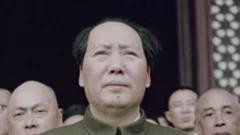
Mao Zedong Dubbing on request
Leaders of Nations • 2021 • 44 minutes
Mao Zedong — the leader under whom China transformed from a backward, semi-colonial country into an industrial nuclear power. He provided China with the most important gifts — ideas of independence and dignity. Chairman Mao elevated China to superpower status. But what price did the Chinese people pay for this historic leap, and what kind of man was Mao Zedong? During his lifetime, his quotations were printed in 800 million copies, second only to the Bible. How is Mao Zedong regarded in modern China? His achievements are viewed as primary, while his mistakes are considered lesser. The Cultural Revolution and the Great Leap Forward remain significant events in history. Mao forced the world to respect China; he made the country a geopolitical power. China measures everything against a long historical perspective, and Mao Zedong will not be forgotten in its history.
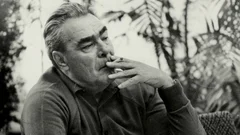
Leonid Brezhnev Dubbing on request
Leaders of Nations • 2021 • 44 minutes
For eighteen years, he led a vast country. Some considered it the USSR’s heyday; others saw it as an era of stagnation when the economy hit a dead end. Unfortunately, Brezhnev is remembered for that, which has overshadowed his achievements. Why was he beloved by the people? What was he like in everyday life? And why did he shy away from radical economic reforms? The film shows how front-line veteran Leonid Brezhnev declared May 9 — Victory Day — a non-working holiday; this will remain his legacy. We see him, together with Hero of the Soviet Union Alexey Maresyev, lighting the Eternal Flame at the Tomb of the Unknown Soldier. Footage of President Richard Nixon’s visit to the USSR is also presented; it was under Brezhnev that the famous "détente" began. In 1975, the historic Helsinki Conference took place, and the film reveals the General Secretary’s key role in these processes. Brezhnev also gave the country the unforgettable 1980 Olympics. Time, not labels, judges a political figure. Leonid Brezhnev was the leader of the people — with his weaknesses and virtues.
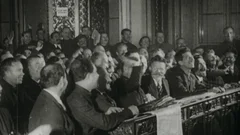
Lev Trotsky Dubbing on request Subtitles available (Russian)
Leaders of Nations • 2021 • 44 minutes
Why was the memory of this man erased during his lifetime? Newsreels and photographs from the revolution have almost not survived. Why did the notion of "fighting Trotskyism" become a guiding principle in Soviet Russia? His contributions to the October Revolution are well known, but his brutal ideas — such as shooting one in ten Red Army soldiers and creating labor armies that were essentially camps — are less familiar. Trotsky’s inhumanity knew no bounds. Comrades called him the "demon" of the revolution. He was a true fanatic, as his biography, widely presented in the film, demonstrates. Why did Stalin hate him, and how did Stalin outmaneuver Trotsky? Trotsky’s death was terrible; after all, the revolution devours its children. In 2002, Lev Trotsky was rehabilitated. Will history do the same for his memory?
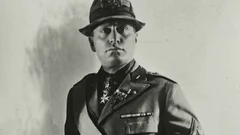
Benito Mussolini Dubbing on request
Leaders of Nations • 2021 • 44 minutes
He called himself the founder of the Second Roman Empire and the father of fascism in Italy. Benito Mussolini was a man who knew how to stir a crowd — a fine orator. He was intoxicated by, and reveling in, power. How did his fate unfold? Was supporting Hitler a fatal mistake? Why did Italians back the fascists, and how did Italian fascism differ from German Nazism? Twenty years at the peak of power: he made Italian trains run on time, launched "battles for grain", founded the famous Roman film studios, and opened the Venice Film Festival. Cinema was always a dictator’s favorite art. How did Mussolini allow Italy to be drawn into a war with the USSR, and what did that mean for the country? How did the famed terrorist and saboteur Otto Skorzeny manage to kidnap il Duce? Could Benito Mussolini have avoided his ignominious end? This film explores these questions.
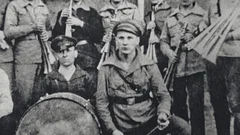
Erich Honecker Dubbing on request
Leaders of Nations • 2024 • 44 minutes
How did the German Democratic Republic live under Erich Honecker? For what purpose was the Berlin Wall built? What became of Honecker after the GDR’s dissolution? For 18 years, Erich Honecker led the German Democratic Republic — the westernmost European country in the socialist camp. Contemporaries called it the "outpost of the USSR in Europe
Nicolae Ceaușescu Dubbing on request
Leaders of Nations • 2024 • 44 minutes
How did Socialist Romania live under Nicolae Ceaușescu? What policies did he pursue toward the Soviet Union and Western countries? And why did the Ceaușescu regime fall in just a matter of days? Nicolae Ceaușescu led the Socialist Republic of Romania for 24 years. The Romanian press called him "Genius of the Carpathians", "The Full-Flowing Danube of Reason", and "The Source of Our Light". However, the November Congress became the last in the history of the Romanian Communist Party. Three weeks after it ended, a revolution broke out in Romania; Nicolae Ceaușescu was arrested, and the Communist Party was banned.
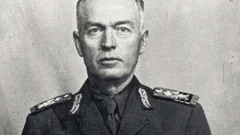
Ion Antonescu Dubbing on request Subtitles available (Russian)
Leaders of Nations • 2024 • 44 minutes
What was the dictatorship of Ion Antonescu like? What actions did the Romanian occupiers undertake on our territory? Additionally, what punishments did the war criminals receive after the war ended? During World War II, Ion Antonescu led the Kingdom of Romania, which the marshal liked to call Greater Romania. He aimed to expand his empire’s borders at the expense of occupied Soviet territories.
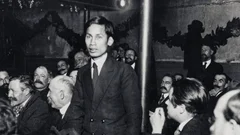
Ho Chi Minh Dubbing on request
Leaders of Nations • 2024 • 44 minutes
Who was Ho Chi Minh in reality — a communist dictator or a national hero? How did he manage to defeat the armies of two of the 20th century’s great powers? What assistance did China and the Soviet Union provide to Vietnam? For more than 30 years Ho Chi Minh led the partisan struggle and battles against foreign invaders, sharing all the hardships and privations of wartime with his soldiers. In the memory of the Vietnamese he remains a symbol of unbending resilience, self-sacrifice, and the will to victory.
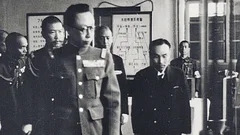
Aisin Gioro Puyi Dubbing on request Subtitles available (Russian)
Leaders of Nations • 2024 • 44 minutes
How did the Japanese use China’s last emperor? What was the state of Manchukuo like? What became of Puyi after the end of World War II? For thirteen years, Puyi headed the puppet empire of Manchukuo. Its true masters were the Japanese, who transformed northeastern China into their colony and a staging ground for a future war against the Soviet Union.