The World on the Eve of Catastrophe. The 20th Century
- История
- 5 episodes
- 2022
Why did interwar Europe — with booming economies and cultures, rising living standards, and diverse social programmes — ultimately come to the bloodiest catastrophe in human history?
Hosts
Episodes
The Hyena of Europe Dubbing on request Subtitles available (Russian)
The World on the Eve of Catastrophe. The 20th Century • 2022 • 44 minutes
In September 1940, the Germans held a triumphant parade in Warsaw. Nazi Germany was celebrating the first anniversary of the conquest of Poland. On the central Piłsudski Square, the parade was reviewed by the Reich’s top leaders — Governor-General Hans Frank and one of the Führer’s closest associates, head of the Reich Labour Service, Konstantin Hierl. The Germans’ victorious procession ended with the renaming of Piłsudski Square as Adolf Hitler Square. This symbolic act, intended by its organizers, was meant to erase the memory of the once independent Polish Republic. For centuries, the medieval Polish–Lithuanian Commonwealth had been one of the largest powers in Eastern Europe. The new Polish republic was headed by General Józef Piłsudski. He was born in 1867 in the suburbs of Vilnius into a wealthy noble family. He called the new regime a “sanation”, or cleansing policy. He dismissed or arrested all unsuitable politicians. In 1934, the first Polish concentration camp was built in Bereza Kartuska for this purpose. Over eight thousand people passed through it in total. Piłsudski’s dictatorship was often called the “rule of the colonels”. Wounded and devastated, Poland was finally liberated by Soviet troops in early 1945. The decision to recreate the Polish republic and establish its postwar borders was made at the Yalta Conference.
The Phoney War Dubbing on request Subtitles available (Russian)
The World on the Eve of Catastrophe. The 20th Century • 2022 • 44 minutes
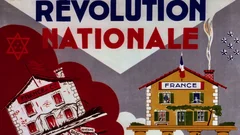
On June 23, 1940, the central streets of Paris awoke to the sounds of German military marches. Columns of marching soldiers appeared on the Champs-Élysées near the Arc de Triomphe. These units belonged to the Wehrmacht’s 18th Army. Just days earlier, the French government had fled its own capital, surrendering Paris to the mercy of the victors. In June 1940, France descended into chaos. Millions of people, gripped by panic, fled the cities following the routed army. The surrender of Paris filled the French with horror and despair. On June 11, when the French government fled the capital and declared Paris an “open city”, crowds of Parisians streamed southward. Hitler divided the defeated France into two parts: the north and the entire Atlantic coast were occupied by the Wehrmacht, while the southern regions were declared a free zone under the control of the Pétain government. The marshal and his ministers moved to the small resort town of Vichy. Thus, the new name “French State” — the Vichy regime — appeared. Under the terms of the armistice, the French army and navy were to be completely disarmed. The new armed forces — the so-called “armistice army” — performed mainly police functions and were limited to no more than one hundred thousand men. The Vichy regime became an ally of the Hitlerite Reich. Nevertheless, the “French State” was recognized by the world’s leading powers.
Spanish Golgotha Dubbing on request Subtitles available (Russian)
The World on the Eve of Catastrophe. The 20th Century • 2022 • 44 minutes
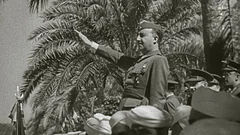
In 1939, the full-length documentary film Spain was released in Soviet cinemas. The film’s director, Honoured Artist of the RSFSR Esfir Shub, dedicated her work to the bloodiest European conflict of the mid-1930s — the Spanish Civil War. In spring 1931, nationwide municipal elections were held in Spain. The Republican parties won them. Soon after, King Alfonso XIII left the country, and Spain was proclaimed a republic. In just five years, the country experienced twenty government crises. In the 1936 parliamentary elections, the people — tired of empty promises and endless party squabbles — voted for communists and socialists. As a result, a government known as the Popular Front was formed. On the evening of July 17, 1936, Spanish colonial troops in Morocco rose against the republican government. The next day, July 18, the uprising spread to mainland Spain. In total, 14,000 officers and 150,000 soldiers joined the insurgents, while about the same number of military personnel — mainly in the navy and air force — remained loyal to the republican government. The Spanish army, and the country with it, divided into two warring camps. Thus, the civil war in Spain began.
The Windsor Files Dubbing on request Subtitles available (Russian)
The World on the Eve of Catastrophe. The 20th Century • 2022 • 44 minutes
There are still many gaps in the biography of the English king Edward VIII. After the end of World War II, American intelligence conducted a special investigation that uncovered at least 60 documents containing correspondence between Edward and high authorities of Nazi Germany. The British government considered the “Marburg Files” extremely dangerous. On the eve of World War II, many British politicians viewed close ties, and even a possible alliance with Nazi Germany, as a forced necessity. British elites blamed the young communist state — the Soviet Union — for the misfortunes that befell the empire. In 1924, British intelligence published a letter supposedly signed by Comintern head Grigory Zinoviev, calling on British communists to begin subversive work in the army and navy. The “Zinoviev letter” was later recognized as a forgery. However, the anti-Soviet hysteria that had begun in Britain could no longer be stopped.
Weimar Republic Dubbing on request Subtitles available (Russian)
The World on the Eve of Catastrophe. The 20th Century • 2022 • 44 minutes
On July 27, 1932, the leader of the National Socialist German Workers’ Party, Adolf Hitler, arrived in the provincial German town of Eberswalde. In the elections held in November 1932 the Nazi Party won by a large margin. Hitler managed to gain 33 percent of the vote, while the nearest Social Democratic Party received only 20. These were the last free all-German elections before the Nazis finally seized power. On March 22, 1933, the first concentration camp of Nazi Germany was opened in Dachau near Munich. After the start of World War II prisoners of war were brought to Dachau in large numbers. About 250,000 people from 24 countries passed through this camp.