Allies of the Third Reich
- История
- 5 episodes
- 2025
On the tragic day of June 22, 1941, war began between the great Eurasian power — the USSR — and another coalition of European states. Alongside the Wehrmacht, troops from Romania, Finland, Italy, Hungary, Slovakia, Croatia, and Austria invaded Soviet territory. How did such diverse states and peoples end up on the same side of the front with Nazi Germany? Who and why became Hitler’s allies?
play_arrow TrailerEpisodes
Western Europe Dubbing on request
Allies of the Third Reich • 2025 • 44 minutes
During World War II, more than half a million volunteers from various European countries served in the German army. In the final stages of the war, every second SS man of the Third Reich did not hold a German passport. Tens of thousands of natives from Belgium, the Netherlands, France, Denmark, and Scandinavia donned German uniforms and swore allegiance to Hitler, driven by racial beliefs and greed. The Flemish SS Legion became one of the first foreign formations of the German army. It was created in Brussels in May 1940 and recruited natives of northern Belgium — the Flemings. Recruitment into the racial vanguard of the Third Reich was carried out in most German-occupied countries of Western and Northern Europe. Each SS man swore loyalty personally to Adolf Hitler and pledged to carry out any of his orders. Even the formally neutral Switzerland rendered invaluable services to the Third Reich. Its financial and commercial elites reaped enormous profits from World War II. The Swiss Red Cross also aided the German army; from 1941 to 1943, it equipped and sent four medical missions to the Eastern Front — about 250 people in total. In northern continental Europe, the Kingdom of Denmark provided a reliable rear for the Nazi Reich.
Bulgaria Dubbing on request
Allies of the Third Reich • 2025 • 44 minutes
In two wars, the Bulgarians found themselves on the side of Russia's opponents and, to a large extent, the opponents of Slavic interests. For Slavic peoples, the German question has always been an extremely sensitive issue. Thus, the Bulgarians ended up, so to speak, on the wrong side in the two great wars of the 20th century. In the Balkans, Bulgaria has the status of a kind of untrustworthy “Trojan horse”. In fact, the Bulgarians were regarded as backstabbers. In postwar Bulgaria, it was not customary to recall the alliance with Nazi Germany. Any research on this topic was categorically forbidden. Many facts about the close ties between Bulgarian elites and leaders of the Third Reich, as well as the aid Bulgaria provided to the Nazis, only became known in the 1990s. Naturally, during Soviet times—when Bulgaria became part of the socialist camp, a full member of the Council for Mutual Economic Assistance and the Warsaw Pact—people, for political reasons, tried not to reopen old wounds or highlight this painful issue.
France Dubbing on request
Allies of the Third Reich • 2025 • 44 minutes
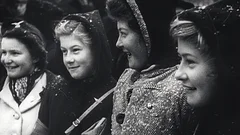
During World War II, more French people served the Germans than citizens of any other Western European country. Tens of thousands of French volunteers served in the Wehrmacht, volunteer legions, and various SS formations. The French worked in German military factories and served in the German navy, air force, intelligence services, the Gestapo, and civil administrations. According to the Nazis themselves, more than 350,000 French citizens served the Third Reich in various capacities during the war. Fascist parties and movements had appeared in France long before World War II began, and by the mid-1930s, their ranks numbered over half a million people.
Scandinavia Dubbing on request
Allies of the Third Reich • 2025 • 44 minutes
A secret agreement on military cooperation between Finland and Nazi Germany was signed in September 1940. During numerous clandestine negotiations with representatives of the Third Reich, Marshal Mannerheim assured the Führer that Finland would provide all necessary assistance in the event of a war with the Soviet Union. In the summer of 1941, the Finns not only supplied the Wehrmacht with airfields, roads, ports, and other military infrastructure but also willingly joined the Nazi campaign to the East. Finnish troops, hardened by the Winter War, had extensive experience fighting in Arctic conditions. In the autumn of 1941, one hundred thousand Finnish soldiers invaded the Soviet Union. They managed to occupy much of Karelia, capture the cities of Vyborg and Petrozavodsk, and establish a blockade of Leningrad from the north. For more than three years, Finland’s allies helped the Germans hold the northern flank of the Eastern Front.
Croatia Dubbing on request
Allies of the Third Reich • 2025 • 44 minutes
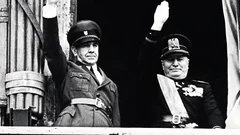
The 369th Reinforced Infantry Regiment, also known as the Croatian Legion, was formed in Zagreb in July 1941. In August 1941, Croatian legionnaires were deployed to the southern sector of the Eastern Front. Over the next two and a half years, they marched from the Dniester to the Volga and fought in battles at Kremenchuk, Kirovohrad, Poltava, Kharkiv, Voronezh, Kalach, and Stalingrad. When it became clear that Hitler’s blitzkrieg had failed, Croatian legionnaires abandoned their positions and began looting frontline villages. For this, the residents of occupied Ukraine nicknamed the Croatian Legion the “Devil’s Regiment”. Even their own officers could not always curb or rein in the Croatian marauders. In February 1943, several SS units were formed in Croatia, mainly recruiting Bosnian Muslims. The role of the independent State of Croatia, which existed from 1941 to 1945, was that of a loyal, reliable ally of Nazi Germany — a state entirely fascist in its ideology.